Human Organ Atlas: Revolutionary 3D Medical Imaging with 100x Greater Precision
Discover how the Human Organ Atlas uses advanced X-ray technology to create the most detailed 3D maps of human organs ever achieved, transforming medical diagnosis and treatment.
The Human Organ Atlas represents a revolutionary breakthrough in medical imaging technology, utilizing advanced X-ray techniques to create the most detailed 3D maps of human organs ever achieved. This groundbreaking project delivers unprecedented precision in medical imaging, with resolution capabilities up to 100 times greater than traditional CT scans, fundamentally transforming how healthcare professionals understand organ structure and disease progression.
Revolutionary HiP-CT Technology
The Human Organ Atlas utilizes Hierarchical Phase-Contrast Tomography (HiP-CT), a cutting-edge imaging technique that bridges the gap between macro and micro-scale medical imaging. While traditional CT scans and MRI can achieve resolution down to just under a millimeter, and histology or electron microscopy can provide sub-micron precision on small tissue samples, HiP-CT uniquely combines these capabilities to image entire organs in 3D with micrometer-level detail.
According to Peter Lee, head of the project, "HiP-CT brings these scales together in 3D, imaging whole organs to provide new insights into our biological structure." This technology enables healthcare professionals to visualize complete organ systems with cellular-level detail, revolutionizing diagnostic capabilities and treatment planning processes.
Clinical Applications and COVID-19 Research
The atlas includes detailed 3D images of organs from COVID-19 patients, providing unprecedented insights into how the disease affects organ function. Researchers have been able to study in detail how COVID-19 interrupted blood oxygenation in lung tissue, offering critical data for understanding disease mechanisms and developing more effective treatments.
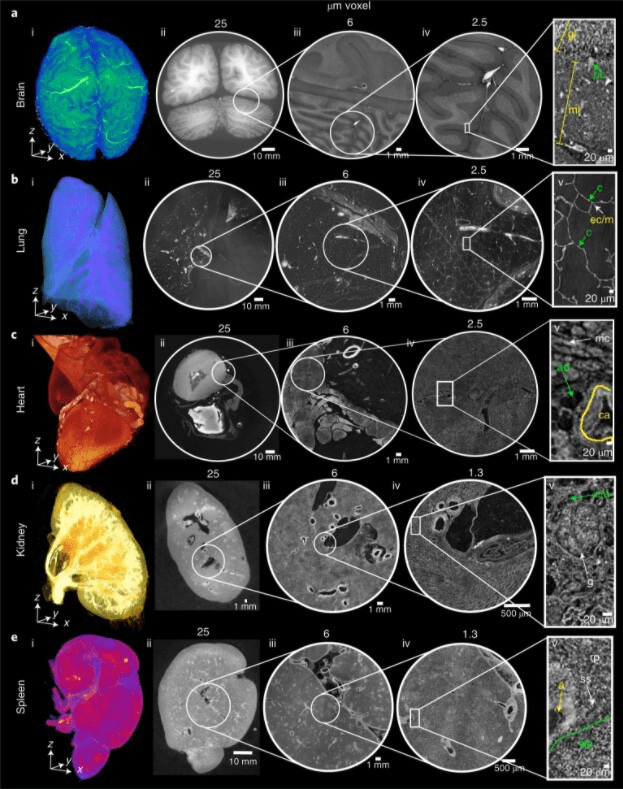
Paul Tafforeau, ESRF scientist, explains: "This technology allows us to see in 3D the incredibly small vessels inside an entire human organ, which allows us to distinguish in 3D a blood vessel from the surrounding tissue and even observe some specific cells." This level of detail enables healthcare providers to identify disease patterns and vascular changes that were previously invisible with conventional imaging methods.
Healthcare Technology Integration
The Human Organ Atlas represents a significant advancement in healthcare technology that will require substantial integration with existing medical imaging systems and EHR platforms. Healthcare organizations will need to adapt their IT infrastructure to handle the massive datasets generated by HiP-CT imaging, which can be hundreds of times larger than traditional medical images.
For healthcare IT professionals, this technology presents both opportunities and challenges. The detailed imaging data must be seamlessly integrated with patient records, accessible to multiple specialists, and stored in compliance with healthcare data regulations. Advanced visualization tools and high-performance computing resources will be essential for healthcare providers to fully utilize this technology.
Building a Comprehensive Disease Library
The project's long-term vision includes creating a comprehensive "library of diseases" featuring high-resolution 3D images of both healthy and diseased organs. This database will serve as an invaluable resource for medical education, research, and clinical decision-making, providing healthcare professionals with detailed reference materials for diagnosis and treatment planning.
The comparison between healthy lung tissue and COVID-19 affected lungs demonstrates the atlas's potential for advancing our understanding of disease progression. As the library expands to include various conditions and organ systems, it will become an essential tool for medical professionals worldwide, supporting evidence-based medicine and improving patient outcomes.
Healthcare Data Management Impact
The Human Organ Atlas will generate massive amounts of high-resolution medical data, requiring healthcare organizations to invest in advanced data storage, processing, and visualization technologies to fully leverage this breakthrough imaging capability.
This revolutionary imaging technology represents the future of precision medicine, where detailed organ mapping will enable personalized treatment approaches based on individual anatomical variations and disease patterns. Healthcare organizations that prepare their technology infrastructure for this advancement will be positioned to deliver superior patient care through enhanced diagnostic capabilities.
Ready to Transform Your Business?
Let's discuss how our expertise can help you achieve your goals.
Get Started Today